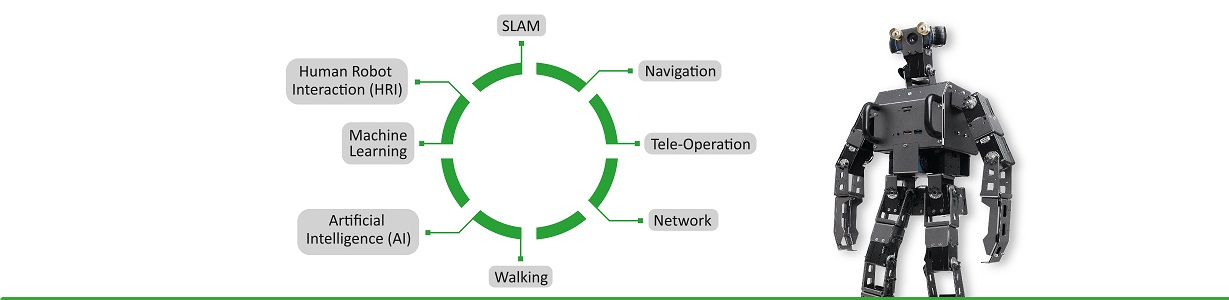
[Unitree G1] Current Unitree G1 capability?

I have 40 years software development experience, but none in robotics. I’m considering getting a Unitree G1 EDU but having a hard time discovering exactly what the current capabilities are. I have some general questions and perhaps someone here can give some guidance. Really what I want is something that can perform some basic functions in the home, that I can build on.

  • Need something that has basic capability that I can build on. Don’t want to start from scratch.
  • Object identification VLM installed? (Visual Language Model) Which one? Open source?
  • High level API for movement. Where are we at?
    • For instance “Pick up red water bottle” within reach. Are we there?
  • G1 EDU vs G1 basic. Can the EDU do everything the basic can, out of the box?
  • What about MindOn. Add-on to basic version? Then why can’t I add on to basic version?

I appreciate any thoughts or comments you might have.

  • Karl
  • The G1 Edu has alot of base software and open source examples already available
  • VLM by default is not installed. Opensource versions are available but it takes time to deply on your robot and is not a one click solution
  • You have 2 options
    • High-Level Mode: In this mode you can control the robot via command velocities (i.e. cmd_vel), for movement. In the back end it uses the default RL gait planning of unitree. This is for most cases sufficient walking around and in rough terrain. However, in cases where the robot has to bend squat or climb stairs in those cases you have to use low-level mode. ALso in high-level mode the arms can be controlled individually, like a traditional robotic arm
    • Low-Level Mode: In this mode you have to manually, control all the joints from head to toe. And control can be via classical control like Boston Dynamics Atlas modelling the kinematics of the system or using RL. There are many RL examples online that are directly deployable. Also cane be used with Meta ques or VR systems for teleoperation.
  • For picking and placing this can be done with Nav2 stack perception is available with perception stack, it is possible but again as to be pieced together for each usecase and is not readily available.
  • G1 EDU can be programmed, where as the non-edu versions cannot be programmed and are like toys that can do predefined routines from a controller or an app.
  • No-add on to base version because even if you did you dont have access to the computer and can use it with that. If you want to program in any capacity it should be an edu version.

Thank you Sohail, that is VERY helpful!